Overview
Mapúa University recognizes that achieving the Sustainable Development Goals (SDGs) requires collaboration among higher education institutions, government agencies, non-government organizations, industry partners, communities, and international stakeholders. Through sustainability reporting, SDG-focused education, community engagement, international collaborations, research partnerships, and multi-sector initiatives, the University contributes to the advancement of the SDGs while strengthening partnerships that support sustainable development.
Publication of Progress Against the Sustainable Development Goals
Sustainability Reporting
Mapúa University publicly reports its sustainability initiatives, programs, policies, targets, and performance indicators through its annual Sustainability Report.
The Sustainability Report documents institutional initiatives and progress related to the United Nations Sustainable Development Goals and serves as a mechanism for transparency, accountability, stakeholder engagement, and continuous improvement.
The University publishes progress against:
- SDG 1: No Poverty
- SDG 2: Zero Hunger
- SDG 3: Good Health and Well-Being
- SDG 4: Quality Education
- SDG 5: Gender Equality
- SDG 6: Clean Water and Sanitation
- SDG 7: Affordable and Clean Energy
- SDG 8: Decent Work and Economic Growth
- SDG 9: Industry, Innovation and Infrastructure
- SDG 10: Reduced Inequalities
- SDG 11: Sustainable Cities and Communities
- SDG 12: Responsible Consumption and Production
- SDG 13: Climate Action
- SDG 14: Life Below Water
- SDG 15: Life on Land
- SDG 16: Peace, Justice and Strong Institutions
- SDG 17: Partnerships for the Goals
Evidence: 2024–2025 Mapúa University Sustainability Report
Education for the Sustainable Development Goals
Commitment to Meaningful Education on the SDGs
Mapúa University integrates sustainability principles and the Sustainable Development Goals into its educational framework through curriculum integration, institutional initiatives, research activities, and student engagement programs.
The University’s commitment to sustainability education ensures that students develop knowledge, skills, and competencies necessary to contribute to sustainable development within their professions and communities.
Sustainability concepts are embedded across various academic programs and courses, making SDG-related learning accessible and relevant to students from multiple disciplines.
Sustainability and SDG-Related Academic Programs and Courses
MAPUA has long been an advocate for environmental conservation and engineering, as demonstrated by its comprehensive program offerings:
MAPUA strongly promotes environmental and sustainable development (ESD) principles within its curriculum:
- The BS Environmental and Sanitary Engineering curriculum includes 17 units focused on environmental protection and conservation.
- Environmental engineering and environmental science courses are integrated into all engineering and non-engineering programs.
- The 3BIRDS criteria are applied in major design courses within the BS Civil Engineering program.
- The BS Architecture program offers a specialization track in Sustainable Design.
- The MS Architecture program includes a specialization track in Sustainable Architecture.
- The BS Industrial Design program features a course on Sustainable Design.
- Sustainable Design Principles are embedded in Architectural Design courses, particularly in Architectural Design 4 – Vernacular Architecture and Ecological Design.
- The BS Interior Design program offers an elective course on Sustainable Design Principles and Techniques.
- MENV631 Sustainability Engineering is one of the core subjects for MS in Environmental Engineering.
Outreach Educational Activities for the Wider Community
Mapúa University extends sustainability education beyond the campus through community engagement and extension programs implemented by the Office for Social Orientation and Community Involvement Programs (SOCIP).
Educational outreach activities benefit:
- 校友
- Local communities
- Community leaders
- Local government stakeholders
- Schools and educational institutions
- Underserved communities
Examples include:
- Community sustainability workshops
- Renewable energy education programs
- Environmental awareness campaigns
- Community conferences
- Water and sanitation education activities
- Capacity-building programs on sustainable development
These initiatives promote sustainability literacy and SDG awareness among a wide range of community stakeholders.
Relationships to Support the Goals
Participation in SDG Policy Development and Planning
Mapúa University collaborates with government agencies, local government units, community organizations, and development partners in initiatives that contribute to the planning, implementation, and advancement of sustainable development programs.
Through partnerships with organizations such as the Office of the Presidential Adviser on Peace, Reconciliation and Unity (OPAPRU) and local government units, the University contributes technical expertise, community-based interventions, capacity-building activities, and sustainable development initiatives that support national and local development priorities.
Government Advisory Panels & Technical Working Groups: Mapúa faculty experts across engineering, architecture, and environmental sciences sit on technical committees, advisory boards, and consultation workshops for national government agencies (such as the Department of Science and Technology, Department of Environment and Natural Resources, and local government planning offices). They provide technical inputs for environmental impact assessments, climate resilience roadmaps, and urban infrastructure policies.
Expert Policy Consultations & Public Hearings: Faculty researchers frequently participate in formal government policy reviews and congressional or local legislative consultations, offering scientific modeling, data analysis, and technical frameworks regarding water resource management, renewable energy transition, and disaster risk reduction.
National and International Standard-Setting Bodies: Mapúa professors actively contribute to professional associations and national standard-setting committees (e.g., in civil engineering, architecture, and information technology) that draft regulatory codes, green building guidelines, and sustainability standards adopted by national industries and regulatory authorities.
Network-Wide Strategic Convocations (iPeople Sustainability Summit): Annual cross-sector organization summits hosted across the iPeople education network (including Mapúa University) serving as a collaborative convergence for academic leadership, corporate strategy, and external institutional partners to align higher education frameworks with national net-zero and climate action agendas.
Alumni and Industry Curriculum Summit: Strengthening Multi-Stakeholder Partnerships
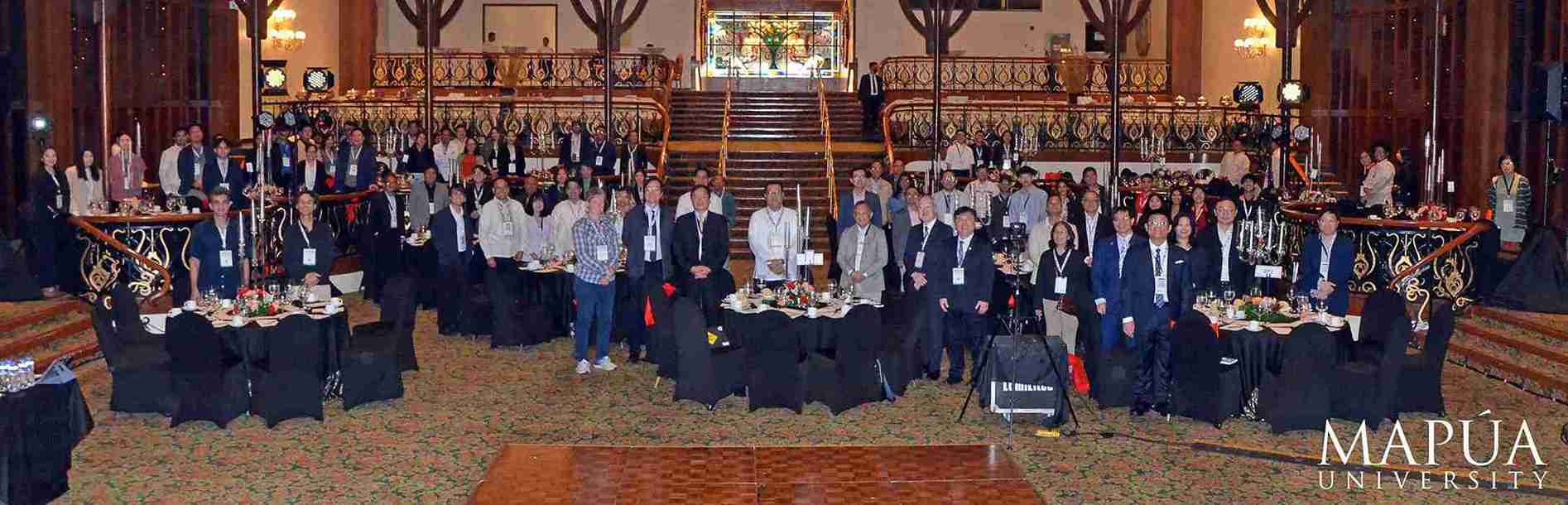
On 20–21 June 2025, Mapúa University held its annual Alumni and Industry Curriculum Summit through the Innovation and Development Office for Career Advancement and Lifelong Learning (idCALL). The two-day event convened alumni, industry leaders, academic experts, and University leaders to review and strengthen curricula in response to evolving workforce, sustainability, and technology needs.
The summit emphasized closer collaboration between academia and industry to address skills gaps, promote sustainability and energy efficiency, advance digital and artificial intelligence literacy, and support upskilling and reskilling. Discussions also highlighted interdisciplinary learning, civic responsibility, innovation, and entrepreneurship as key elements of future-ready education.
Through the summit, Mapúa strengthened partnerships with alumni and industry stakeholders in shaping a resilient, relevant, and sustainability-oriented curriculum. This initiative supports SDG 17 by promoting multi-stakeholder collaboration for quality education, innovation, and national development.
Partnerships for Micro-Credentials and Program Development
Mapúa University established new partnerships to expand micro-credential and academic program opportunities that respond to evolving industry needs. These collaborations help align learning offerings with emerging technologies, workforce requirements, and professional development priorities.
By working with industry partners to strengthen skills development and lifelong learning opportunities, Mapúa advances SDG 17 through academia-industry collaboration that supports innovation, employability, and sustainable economic transformation.
Cross-Sectoral Dialogue on the SDGs
17th Community Conference 2024
On 06 December 2024, Mapúa University, through the Office for Social Orientation and Community Involvement Programs (SOCIP), organized the 17th Community Conference: Active Involvement in the Age of Artificial Intelligence.
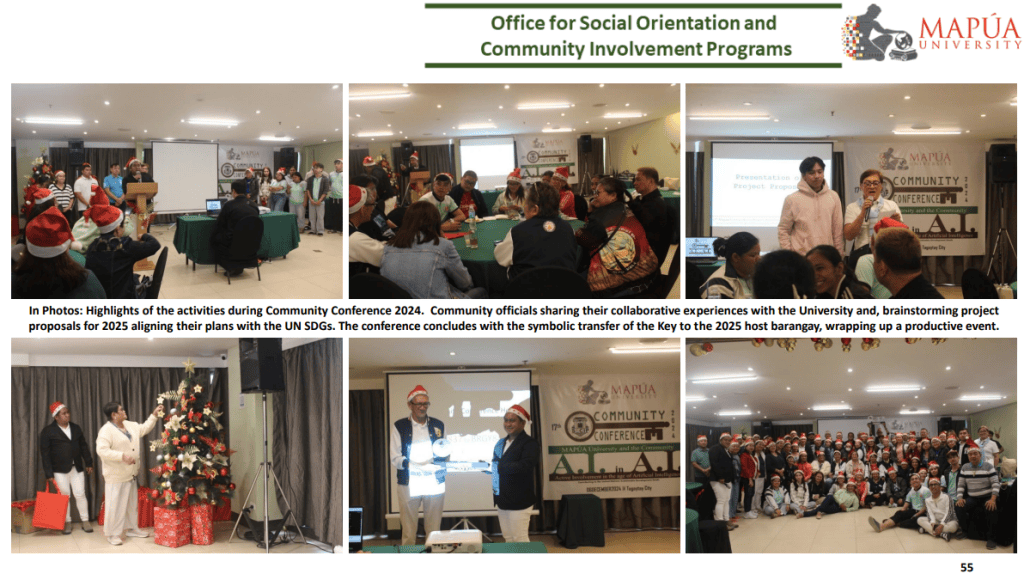
The conference gathered 71 community representatives, including barangay chairpersons and council members, alongside university representatives and community stakeholders.
Participants reviewed community engagement initiatives and proposed future programs focused on:
- SDG 6: Clean Water and Sanitation
- SDG 7: Affordable and Clean Energy
- SDG 16: Peace, Justice and Strong Institutions
The conference provided a platform for dialogue, collaboration, knowledge exchange, and partnership development between the University, communities, and local government representatives.
International Collaboration for the SDGs
International Collaboration on Gathering and Measuring SDG Data
Mapúa University participates in international sustainability assessment and reporting initiatives that support the measurement, monitoring, benchmarking, and communication of sustainability performance.
Through participation in international rankings, reporting frameworks, research collaborations, and sustainability benchmarking exercises, the University contributes to the collection, analysis, and dissemination of sustainability-related information associated with the SDGs.
These activities support institutional improvement while contributing to wider discussions on sustainable development within higher education.
International Collaboration and Research for SDG Best Practices
Mapúa University collaborates with international academic institutions, organizations, and research partners to exchange knowledge, develop innovative solutions, and identify best practices related to sustainable development.
Through international research collaborations, academic partnerships, conferences, and networking activities, the University contributes to the advancement of knowledge and the sharing of sustainability practices across borders.
These collaborations support the continuous improvement of institutional approaches toward achieving the SDGs.
International Month 2025: Strengthening Global Academic Partnerships
On 9 October 2025, Mapúa University launched its International Month Celebration 2025, gathering approximately 100 onsite participants at the Intramuros Campus and 200 online participants through a hybrid program of research, cultural exchange, and scientific discussion.
The celebration strengthened partnerships with international institutions and experts from Japan, the United States, the Czech Republic, Spain, and France. Activities included an International Seminar on Sustainable Materials, Chemistry, and Chemical Engineering; a scientific workshop on soil and water pollution from tire particles; and a poster presentation involving student researchers from Mapúa University and Okayama University of Science.
Through these engagements, Mapúa expanded international research collaboration, academic exchange, and knowledge-sharing on sustainability-related challenges. The initiative demonstrates the University’s contribution to SDG 17 by building cross-border and multi-stakeholder partnerships that advance sustainable development.
International Conference on Sustainable Environmental Technologies (ICSET) 2025
From 21–23 January 2025, Mapúa University hosted ICSET 2025 in partnership with National Chung Hsing University. The conference convened around 250 academics, industry researchers, and students from different countries to exchange research and develop solutions for environmental sustainability and the SDGs.
Mapúa also formalized partnerships with the Philippine Reclamation Authority and Aston University to support joint research, student immersion, sustainability initiatives, dual-degree programs, and global academic exchange. These activities demonstrate Mapúa’s commitment to SDG 17 through multi-stakeholder and international partnerships for sustainable development.
Collaboration with Non-Government Organizations and Community Partners
Student Volunteering Programs
Mapúa University works with community organizations, civil society groups, and development partners to provide volunteering opportunities that contribute to sustainable development objectives.
Student volunteers participate in initiatives involving:
- Community development
- Environmental sustainability
- Education
- Health and well-being
- Disaster resilience
- Social development
These programs allow students to apply their knowledge and skills while supporting community needs.
Community-Based Research Programs
The University collaborates with government agencies, communities, and partner organizations in the development and implementation of research programs that address societal and environmental challenges.
Research collaborations support evidence-based solutions and contribute to the achievement of the Sustainable Development Goals.
Development of Educational Resources
Mapúa University partners with external organizations and stakeholders in creating educational materials, capacity-building activities, awareness campaigns, and learning resources that promote sustainable development.
These collaborative efforts support knowledge dissemination and encourage broader public participation in sustainability initiatives.
Strategic Partnerships for Sustainable Development
Mapúa University recognizes that sustainable development requires strong partnerships across sectors and disciplines. Through sustainability reporting, SDG-focused education, government collaboration, community engagement, international partnerships, research initiatives, and volunteer programs, the University actively contributes to the implementation of the Sustainable Development Goals while strengthening partnerships that generate positive impacts for society and the environment.