Join Mapúa University’s Electronics Engineering program and transform your passion for electronics into a thriving career, mastering the technologies that drive modern engineering solutions.

可持续性
关于马普瓦
The A.Y. 2026-2027 online application for incoming Grade 11 and College freshmen are now open. Click here to begin!
Master Electronics Engineering with a Bachelor’s Degree at Mapúa
Sharpen your skills in world-class electronic technologies when you study at Mapúa’s electronics engineering program. This three-year, full-time undergraduate program is recognized as a Center of Excellence by CHED and accredited by ABET and PACUCOA. It offers in-depth training in integrated circuits, robotics, digital signal processing, and more.
Get ready to spearhead innovations in electronics and communications with the Bachelor of Science in Electronics Engineering. Gain access to advanced facilities and a dynamic curriculum crafted to propel your career to new heights.
Ready to apply? Click here!
Blended
Learning Mode
August
Start of Classes for the First Term
18
Scholarships
4 years
Program Length
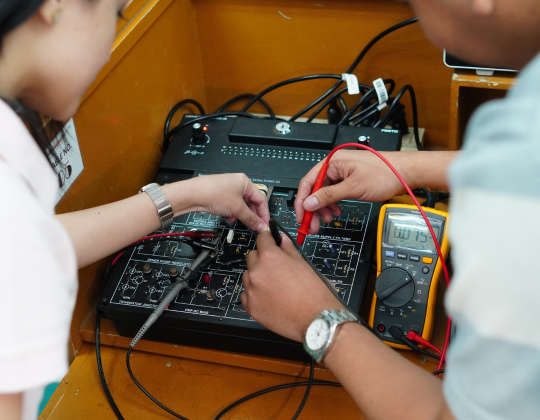
By the time of graduation, the students shall have developed:
1. An ability to identify, formulate, and solve complex engineering problems by applying principles of engineering, science, and mathematics.
2. An ability to apply engineering design to produce solutions that meet specified needs with consideration of public health, safety, and welfare, as well as global, cultural, social, environmental, and economic factors.
3. An ability to communicate effectively with a range of audiences.
4. An ability to recognize ethical and professional responsibilities in engineering situations and make informed judgments, which must consider the impact of engineering solutions in global, economic, environmental, and societal contexts.
5. An ability to function effectively on a team whose members together provide leadership, create a collaborative and inclusive environment, establish goals, plan tasks, and meet objectives.
6. An ability to develop and conduct appropriate experimentation, analyze and interpret data, and use engineering judgment to draw conclusions.
7. An ability to acquire and apply new knowledge as needed, using appropriate learning strategies.
By the time of graduation, the students shall have developed:
a. Apply knowledge of mathematics, natural science, engineering fundamentals, and an engineering specialization to the solution of complex engineering problems.
b. Conduct investigations of complex engineering problems using research-based knowledge and research methods, including design of experiments, analysis and interpretation of data, and synthesis of information to provide valid conclusions.
c. Design solutions for complex engineering problems and design systems, components, or processes that meet specified needs with appropriate consideration for public health and safety, cultural, societal, and environmental considerations.
d. Function effectively as an individual and as a member or leader of diverse teams and in multidisciplinary settings.
e. Identify, formulate, research literature, and analyze complex engineering problems, reaching substantiated conclusions using first principles of mathematics, natural sciences, and engineering sciences.
f. Apply ethical principles and commit to professional ethics and responsibilities and norms of engineering practice.
g. Communicate effectively on complex engineering activities with the engineering community and with society at large, such as being able to comprehend and write effective reports and design documentation, make effective presentations, and give and receive clear instructions.

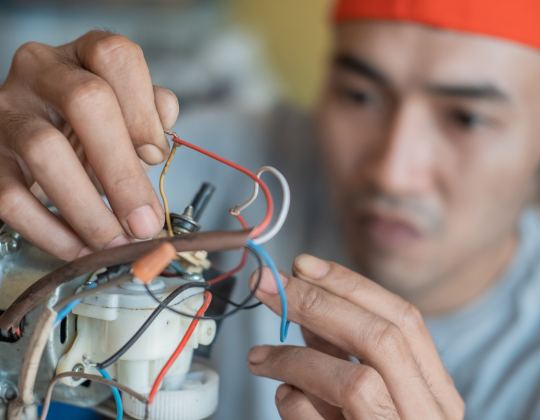
h. Understand and evaluate the sustainability and impact of professional engineering work in the solution of complex engineering problems in a societal and environmental context.
i. Recognize the need for and have the preparation and ability to engage in independent and life-long learning in the broadest context of technological change.
j. Apply reasoning informed by contextual knowledge to assess societal, health, safety, legal, and cultural issues and the consequent responsibilities relevant to professional engineering practice and solutions to complex engineering problems.
k. Create, select, and apply appropriate techniques, resources, and modern engineering and IT tools, including prediction and modelling, to complex engineering problems with an understanding of the limitations.
l. Demonstrate knowledge and understanding of engineering management principles and economic decisionmaking and apply these to one’s own work, as a member and leader in a team, to manage projects and in multidisciplinary environments.
m. Apply knowledge of electronics engineering in at least one specialized field of electronics engineering practice.
Manage and maintain the technical aspects of broadcast systems to ensure uninterrupted service.
Work on systems that enhance connectivity and data transmission across platforms.
Design control systems and instruments for monitoring and optimizing engineering operations.
Specialize in designing and managing complex electronic systems across various sectors.
Focus on creating integrated circuits that meet specific technological needs.
Keep organizational networks running efficiently with up-to-date software and hardware solutions.
Develop and maintain robust network infrastructures that support data communication and system integration.
Ensure the highest standards in the production and operation of electronic systems.
Combine technical knowledge with sales skills to provide businesses with advanced technological solutions.
Analyze, modify, and synthesize signals such as sound, images, and scientific measurements.
Innovate by launching tech startups or introducing new technologies to solve practical problems.
Design and oversee the installation of telecommunications equipment and facilities.
Develop testing protocols to ensure products meet required specifications before market release.